 AI & ML
Quick answer: When is it worth fine-tuning your own AI model?
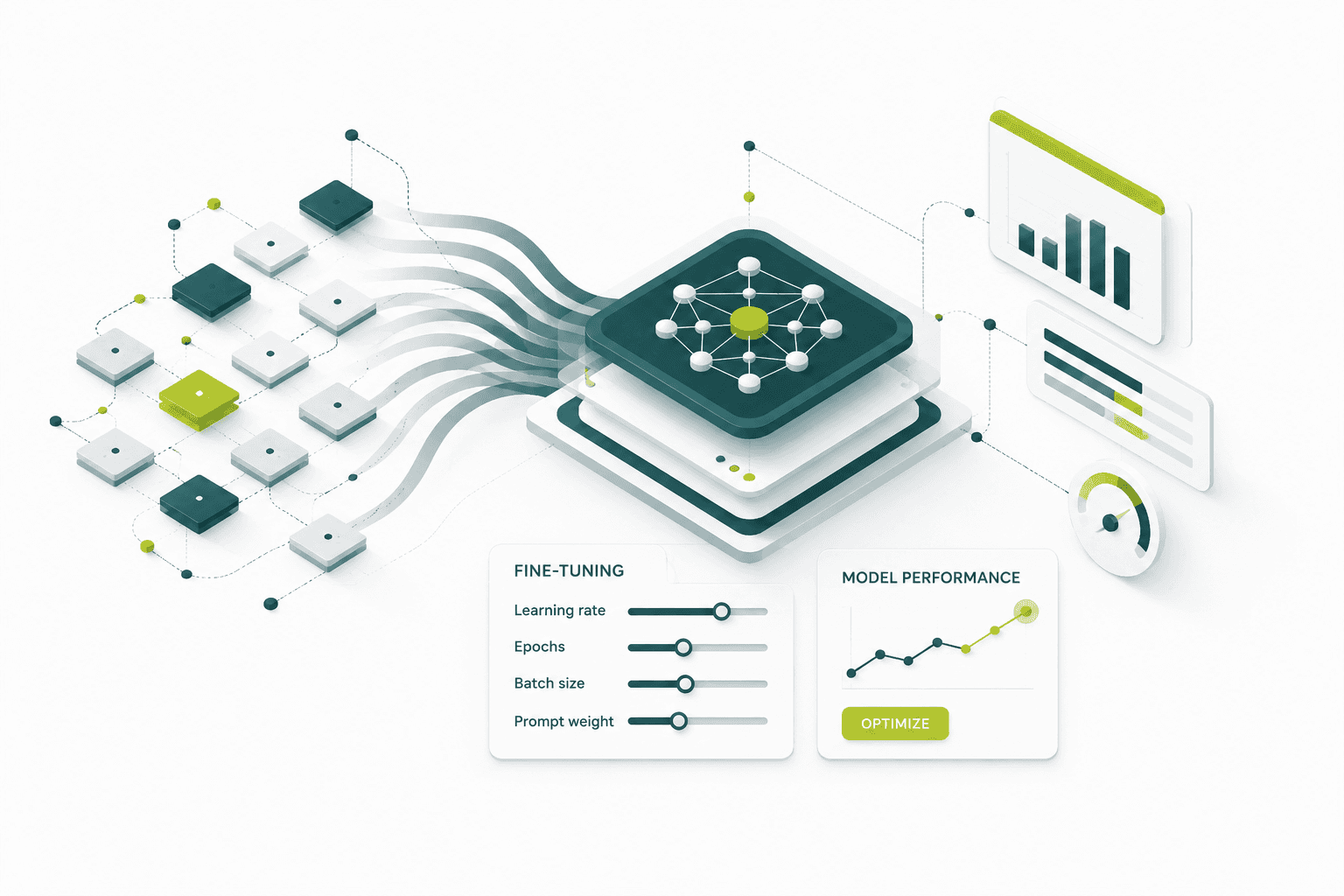
Fine-tuning open-source models (Llama, Mistral, Qwen) means adapting ready-made AI to the specifics of your company.
It pays off when: (1) API tools don't understand your industry terminology, (2) you process sensitive data and need full control, (3) you run 1000+ queries per month and the API becomes expensive.
Cost: PLN 2,000-20,000+ per month for infrastructure + setup of PLN 8,000-40,000.
Implementation time: A pilot in 3-6 weeks, not months. It's the solution between buying a ready-made API and building AI from scratch.
When does off-the-shelf AI stop being enough for business?
Most companies start their AI journey with ready-made tools like ChatGPT or Claude — and rightly so. Deployment is fast, usage is simple and the capabilities are impressive. But sooner or later a familiar problem appears: the model sounds generic, doesn't understand the specialist terms in your industry, or ignores the subtle nuances of internal procedures.
At that point the question changes from "What can we use?" to "What can we build?"
That's exactly when fine-tuning comes in.
Customizing vs building from scratch – clearing up the difference
Let's clear up one common misconception right away.
When we talk about "building" AI for your company, we don't mean training a model from scratch the way OpenAI did with GPT. That would cost millions and require supercomputers. Instead we mean fine-tuning — taking a powerful, already existing open-source model and adapting it to your company's knowledge.
Think of it like furnishing a well-built house to your needs, instead of building it from the foundations.
The most popular models for fine-tuning:
- Llama (Meta) – works well in compliance-demanding applications
- Mistral (a French AI startup) – fast deployments, EU servers
- Qwen (Alibaba) – best for non-English languages, including Polish
Each of them has been trained on huge amounts of data and handles general tasks surprisingly well. Your task is to teach it the specifics of your business context.
Qwen, Mistral or Llama – which model to choose for your company?
Not all open-source models are equal. Here's what matters for business users:
| Model | Best for | Pros | Cons |
|---|---|---|---|
| Llama 3.x | Large companies, regulated industries | Meta support, great documentation, compliance-friendly | Weaker in non-English languages |
| Mistral | European companies, fast deployments | EU servers (GDPR), fast inference | Smaller community than Llama |
| Qwen 2.5 | Multilingual applications, Polish business | Excellent quality in Polish, continuously developed | Less recognition in the West |
Important: Open-source doesn't mean free to run. You still need compute power (usually cloud resources) and technical expertise. "Open" means you control the model, can inspect how it works and aren't dependent on a vendor's pricing.
What is AI fine-tuning and how does it work in practice?
Imagine you've hired a brilliant assistant who knows everything about business in general, but nothing about your business specifically. Fine-tuning is the training period in which it learns:
- The terminology and abbreviations specific to your company
- How you structure reports and communication
- Your brand voice and values
- The industry knowledge relevant to your work
- Your internal processes and workflows
Technically, you take a base model and train it on your proprietary data so it answers like your best employee, not a generic chatbot.
What you need to make it happen:
1. Clean, relevant data Examples of the results you want to achieve: previous reports, approved emails, documented decisions. Quality matters more than quantity.
2. Compute resources Usually cloud GPUs rented by the hour. Your IT team or AI partner handles this.
3. A time commitment Weeks for the first results, not months. Fine-tuning is much faster than people expect.
Most companies use tools like Hugging Face (a platform for AI models) and techniques like LoRA (a memory-efficient way of fine-tuning) without needing to understand the underlying math.
Fine-tuning in action – from general to precise
A real-life example: Mandala for Expander Advisors
Situation: Expander Advisors, a leader in financial brokerage in Poland, needed AI that understood specialist credit terminology and could analyze documents in Polish.
The problem with generic AI: ChatGPT wrote well, but it didn't know their protocols, couldn't reference specific banking products, nor use the nuanced financial language their clients expect.
Solution: Fine-tuning the Qwen 2.5 model on:
- Previous successful loan applications
- Banking product documentation
- Feedback from clients and advisors
- The company's style guide
Result:
- 70% reduction in time to prepare credit analyses
- Zero errors in financial terminology
- Consistent brand voice across all materials
- Drafts need minimal editing instead of a full rewrite
The difference? Their tool learned from their experts, not from general knowledge on the internet.
What nobody will tell you about building your own AI
Fine-tuning sounds great in theory, but here are the realities you should know:
Models drift over time
As your business evolves, so your AI needs retraining. New products, policy changes, updated regulations — everything requires feeding the model fresh data. This is not a one-off project.
Infrastructure isn't free
Running a fine-tuned model comes with ongoing compute costs. Depending on usage, this can be from a few to a dozen-plus thousand złoty per month. Factor it into your ROI calculations.
You need expertise — internal or external
Someone has to manage the model, monitor its performance and handle updates. Many companies partner with AI consultancies instead of building internal teams initially.
Data preparation is harder than you think
Your training data must be cleaned, formatted and representative. The "garbage in, garbage out" rule applies here mercilessly.
The hidden truth: Fine-tuning solves specific problems brilliantly, but creates new operational responsibilities.
5 signs it's time for your own AI model
Here are the clear signs that fine-tuning makes business sense:
1. You've hit a ceiling with API tools
Generic AI works in 80% of cases, but consistently fails on your specific needs.
2. You have valuable proprietary data
Your competitive advantage comes from knowledge that isn't publicly available — and you can't send it to external APIs.
3. Privacy or compliance matters
Regulated industries (healthcare, finance, law) often can't risk sending sensitive data to third-party services.
4. Volume justifies the investment
You run thousands of queries per month. The math starts to favor owned infrastructure over per-use API fees.
5. You have the right resources
A budget for compute resources plus either internal ML talent or a trusted partnership.
Don't build just because open-source is trendy. Build when the business case clearly favors control, customization and long-term cost efficiency.
Data from real Mandala Software House deployments
Analysis of 15 fine-tuning projects in 2024-2025:
- 68% of clients chose Qwen for applications in non-English languages (mainly Polish)
- Average pilot deployment time: 4 weeks
- ROI achieved on average after 6 months of production use
- 85% of projects use a hybrid approach (API for simple tasks + fine-tuned for specialist ones)
- Average cost reduction after 12 months: 40% compared to a pure API approach
- Most common use cases: document analysis (53%), report generation (27%), customer support (20%)
Summary: When does fine-tuning make sense?
Fine-tuning open-source models sits in a sweet spot: more customized than buying API access, far less complex than building AI from scratch.
It makes sense when you need domain-specific precision, data privacy, or when you've hit the limits of general tools. It doesn't make sense if you're just getting started with AI or lack the operational capacity to maintain the model.
How to start? A step-by-step approach:
- Identify a specific problem that generic AI doesn't solve well
- Prepare training data (50-500 high-quality examples)
- Choose a technical partner or build internal capability
- Run a pilot project (4-6 weeks)
- Measure results (accuracy, time saved, ROI)
- Scale only when the benefits are proven
Contact
Mandala Software House specializes in AI transformation for Polish business. We have delivered 15+ fine-tuning projects in 2024-2025, including for Expander Advisors (a leader in financial brokerage).
Get in touch to discuss your case and find out whether fine-tuning is right for your company.
Open-source AI isn't about being free — it's about being in control. For the right business problems, that control is worth every penny invested.
Client testimonial
"Working with Mandala changed the way we work with AI. The fine-tuned Qwen model understands our specialist credit terminology and cut analysis preparation time by 70%. It's no longer a generic chatbot — it's a tool that truly understands the Polish financial market."
— Digital transformation team, Expander Advisors